Leave Your Message
Choosing a Uv Radiation Machine for global use requires more than comparing price, power, or delivery speed. The right choice depends on wavelength, exposure control, equipment quality, and the laws of each target market. A machine that performs well in one country may require different certification, labeling, or safety documentation elsewhere. Requirements can change.
This guide examines practical decisions through a safety-focused and evidence-based lens. It considers intended applications, output stability, shielding, emergency stops, timer accuracy, and maintenance access. For example, an operator should clearly see warning indicators before opening a treatment chamber. A reliable unit should also record operating data and support repeatable procedures. Small details matter.
Real-world experience often reveals issues that product brochures overlook. Replacement lamps may be difficult to source internationally. Local technicians may need specialized training. Electrical standards and plug systems may also differ. These points deserve careful review before purchase. Not every popular model is suitable for every region, and some assumptions may prove wrong after installation. That uncertainty should encourage testing, independent verification, and professional consultation. Buyers should request recognized test reports, supplier references, and clear warranty terms. They should also confirm whether the machine is permitted for its intended use under local regulations. Safe operation depends on trained personnel, controlled access, suitable protective measures, and documented procedures. This article provides a structured starting point for evaluating performance, compliance, reliability, and long-term support across global markets.
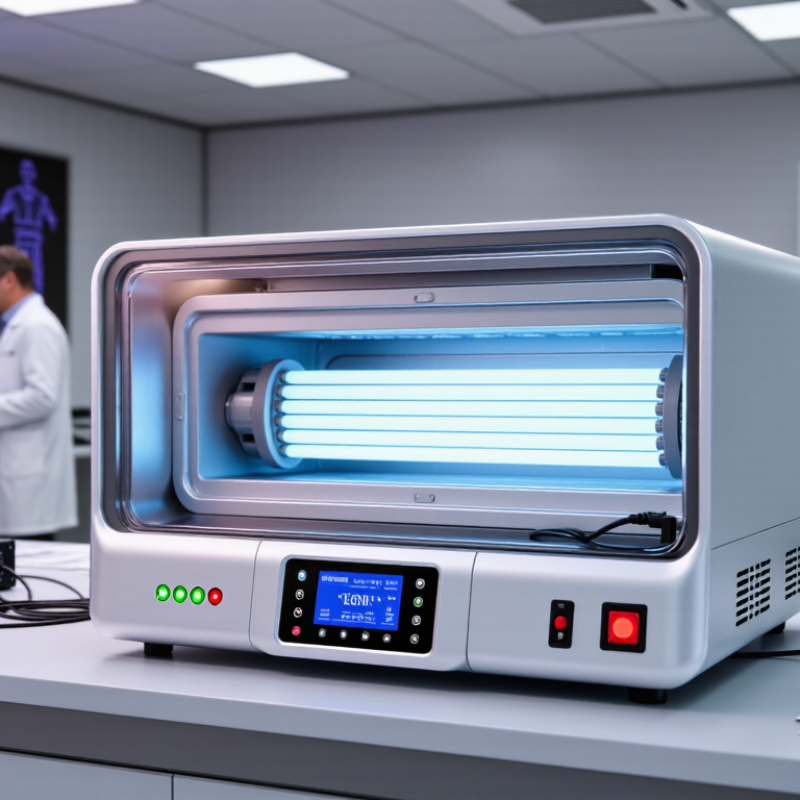
How to Choose a UV Radiation Machine for Global Use?
Identify the Intended Applications and UV Radiation Requirements
Choosing a UV radiation machine starts with the task, not the equipment cabinet. Disinfection, curing, phototherapy, fluorescence inspection, and surface testing require different UV conditions. Define the target material, treatment area, distance, and acceptable result. A machine for water treatment may need controlled flow and continuous monitoring. A unit for a small surface may need even coverage and a shorter exposure cycle. Do not assume “stronger” means better. Excessive UV can damage plastics, coatings, skin, or sensitive components. The intended use sets the safe operating boundary.
Specify the required wavelength before comparing machines. UVA, UVB, and UVC produce different effects, and nearby wavelengths are not automatically interchangeable. Record irradiance in W/cm² or W/m², then calculate dose from irradiance and exposure time. The target dose should come from validated testing, not promotional material. Measure output at the actual working distance. It can fall sharply across a large chamber. Calibrated sensors matter. So does lamp aging.
Global use adds practical questions. Check voltage, frequency, plug configuration, environmental conditions, and local safety requirements. Ask whether the machine displays exposure data and stores operating records. Shielding, interlocks, warning labels, and emergency shutoff should be treated as core functions. I once underestimated uneven exposure in a wide test area; the center passed, while the edges did not. That mistake changed the acceptance test. Repeat measurements after installation, cleaning, and lamp replacement. If the application is unclear, pause the purchase. A technically impressive machine may still be the wrong tool.
| Intended Application | Typical UV Wavelength | Key Exposure Requirement | Machine Selection Considerations | Safety and Validation |
|---|---|---|---|---|
| Drinking-water disinfection | Commonly 254 nm low-pressure UV; medium-pressure systems emit a broader UV spectrum. | Specify a validated UV dose or reduction-equivalent dose for the target organisms and water conditions. A dose of 40 mJ/cm² is used as a reference benchmark in some drinking-water frameworks, but requirements vary by jurisdiction and application. | Check flow rate, UV transmittance, turbidity, lamp aging, sleeve fouling, sensor accuracy, and the validated operating envelope. | Use a reactor validated under a recognized protocol and applicable local drinking-water rules. UV provides no lasting disinfectant residual in the distribution system. |
| Air or surface germicidal treatment | Traditionally around 254 nm; UV-C LEDs commonly operate within approximately 265–280 nm. | Required dose depends on the microorganism, target reduction, distance, exposure time, airflow, shadowing, and surface condition. Determine it through application-specific testing rather than assuming one universal dose. | For air treatment, consider airflow, mixing, residence time, and irradiance distribution. For surfaces, assess line of sight, shadows, distance, and reflectivity. | Direct exposure to UV-C can injure eyes and skin. Use shielding, interlocks, access controls, and appropriate exposure assessment; verify performance with suitable radiometry or biological testing. |
| Medical phototherapy | Narrowband UV-B is typically around 311–313 nm. UVA1 treatment generally uses approximately 340–400 nm. | Exposure is prescribed and adjusted by a qualified clinician according to the treatment protocol, patient response, skin type, and device output. | Look for controlled irradiance, uniform treatment-field coverage, calibrated timers, reproducible positioning, and documented output monitoring. | Use only for the prescribed clinical purpose and in accordance with applicable medical-device rules. Protective eyewear and patient monitoring may be required. |
| UV curing of inks, coatings, and adhesives | Common UVA and near-visible curing bands include 365, 385, 395, and 405 nm; the suitable band depends on the photoinitiator and material. | Control irradiance and total radiant exposure (dose). The required dose depends on the formulation, layer thickness, substrate, line speed, and desired cure properties. | Match the emission spectrum to the material’s photoinitiator absorption. Check working distance, illuminated width, heat sensitivity, line speed, and cure-depth requirements. | Assess eye and skin exposure, ozone generation where relevant, heat, and shielding. Confirm cure quality using tests appropriate to the finished product. |
| Fluorescence inspection and excitation | Common excitation wavelengths include 365 nm UVA and, for some materials, 395 nm or visible violet light. | Choose sufficient irradiance at the sample and the correct excitation band for the fluorescent material; there is no single dose requirement for all inspection tasks. | Consider uniformity, distance, ambient-light rejection, filters, inspection area, and whether the task requires steady or pulsed illumination. | Check the lamp’s spectral output and assess eye exposure, especially during prolonged or close-range inspection. |
| Far-UVC air or surface research and specialized applications | Often centered near 222 nm, typically produced by filtered excimer sources. | Set exposure limits and performance targets according to the applicable safety framework and validated use case; do not infer safety from wavelength alone. | Verify the actual spectrum, including unwanted longer-wavelength emissions, optical filtering, output stability, and intended occupancy conditions. | Follow current occupational exposure guidance and local regulations. Assess the complete spectral output and obtain a qualified safety review before use around people. |
| Global deployment and installation | Confirm that the selected wavelength is appropriate for the process; wavelength alone does not establish treatment performance. | Document the required irradiance, exposure time or dose, operating range, and the method used to verify them. | Check local mains voltage and frequency, plug and wiring rules, environmental conditions, spare-part availability, calibration needs, and language requirements for instructions. | Confirm applicable electrical, optical-radiation, workplace-safety, and product requirements in every destination market. Arrange local compliance review where required. |
Selection note: UV output and treatment effectiveness depend on wavelength, irradiance, exposure time, geometry, and operating conditions. Treat the values above as typical application context, not as a substitute for a validated process, professional assessment, or local regulatory requirements.