Leave Your Message

China Top 10 UV Glue Curing Lamp Suppliers?

Selecting a reliable Uv Glue Curing Lamp supplier requires more than comparing prices or checking product photographs. China has become a major manufacturing base for UV LED systems, adhesive equipment, and industrial electronics. However, supplier quality can vary sharply.

Recent reports from MarketsandMarkets, Grand View Research, and Fortune Business Insights identify strong growth in UV LED applications. Electronics assembly, medical devices, optical components, and consumer products continue driving demand. These reports also highlight energy efficiency, longer operating life, thermal control, and low maintenance as important purchasing factors. Those findings matter on the factory floor. A weak lamp may leave adhesive beneath a metal edge partly uncured.

Curing performance is not only about optical power. Wavelength matching, irradiance stability, exposure distance, cooling design, and dose verification affect bond reliability. As UV-curing specialist Dr. John W. Schaefer has stated, “The adhesive and curing equipment must be treated as one system.” This principle should guide every supplier comparison.

Our China Top 10 Uv Glue Curing Lamp Suppliers review examines more practical evidence. It considers manufacturing experience, LED chip quality, wavelength options, curing uniformity, test documentation, customization, warranty support, and export service. Certifications are useful. They are not enough.

Supplier rankings are never perfect. Application conditions differ. A lamp that performs well on a glass display component may fail on a deep plastic cavity. Buyers should request samples, measured irradiance data, and real adhesive curing tests before ordering. The strongest suppliers explain limitations clearly, rather than promising universal results. That honesty is valuable.
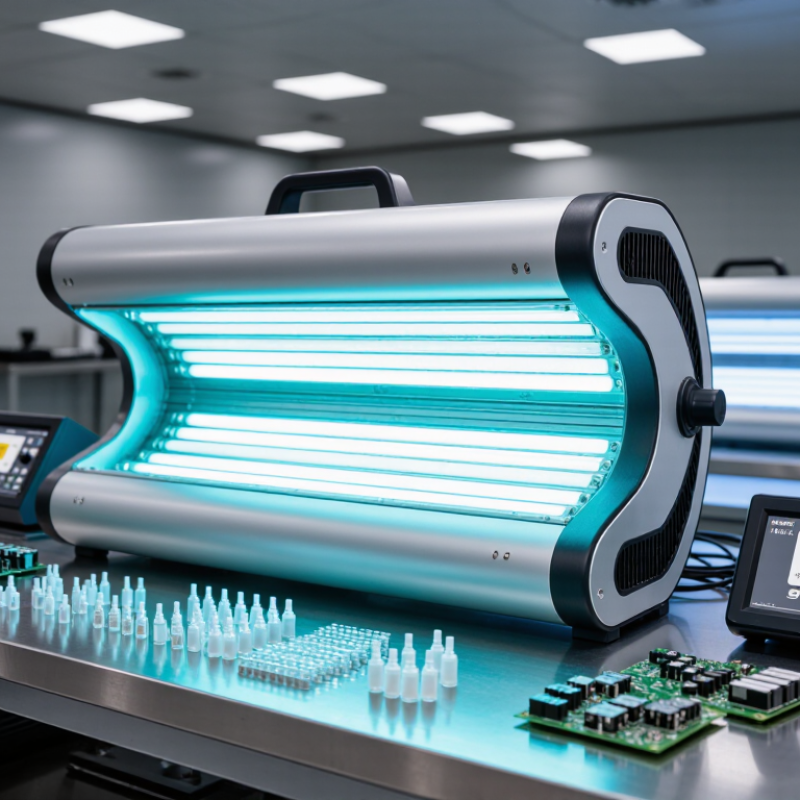
China Top 10 UV Glue Curing Lamp Suppliers?

China’s UV Glue Lamp Market: UV-A 315–400 nm and LED 365–405 nm

China Top 10 UV Glue Curing Lamp Suppliers

China’s UV glue lamp market is moving toward two practical wavelength groups: UV-A mercury lamps at 315–400 nm and LED systems operating around 365–405 nm. The difference is important. UV-A lamps can offer broader spectral coverage, while LEDs usually deliver steadier output, lower heat, and easier maintenance. Grand View Research’s 2024 UV curing market analysis identifies electronics, medical devices, and automotive components as major demand areas. These sectors need controlled curing, not simply brighter light.

For a top-ten supplier review, buyers should examine irradiance, wavelength tolerance, cooling design, and measured curing depth. A 395 nm LED may cure one adhesive efficiently, but a 365 nm formulation can respond poorly under the same unit. Real workshops are messier. Dust, lens distance, adhesive thickness, and aging LED chips change results. The boundary is not tidy.

The International Energy Agency has also reported continuing efficiency gains in solid-state lighting, supporting wider LED adoption in industrial equipment. However, efficiency alone proves little. Request a calibrated irradiance report, usually in mW/cm², plus test results using the buyer’s actual adhesive. MarketsandMarkets’ UV LED industry research highlights electronics manufacturing and industrial automation as key growth applications. Suppliers with optical testing, thermal management, and application support deserve more attention than those offering only low prices. One weakness remains: published data can be incomplete, so independent verification is still necessary.
UV Glue Curing Principles: Irradiance, Dose in mJ/cm², and Cure Time

China Top 10 UV Glue Curing Lamp Suppliers?

UV glue curing depends on irradiance, dose, and cure time. Irradiance is the light power received at the bond surface, measured in mW/cm². Dose is accumulated energy, measured in mJ/cm².

The basic relationship is simple: dose equals irradiance multiplied by time. For example, 1,000 mW/cm² applied for 2 seconds delivers about 2,000 mJ/cm². A 2024 RadTech UV+EB Technology Roadmap identifies 365, 385, 395, and 405 nm as common LED curing wavelengths. The adhesive still decides the required spectrum and dose.

A practical test should measure irradiance at the actual adhesive layer, not beside the lamp. Glass, distance, lens aging, and shadowed joints can reduce delivered energy.

If the measured irradiance is 800 mW/cm², a 1,600 mJ/cm² target theoretically needs 2 seconds. Real production may need longer. The bond may look cured while remaining soft inside.

A 2023 industry technical survey reported that process verification increasingly uses radiometers and dose records, rather than relying only on lamp settings. This is sensible, but imperfect. Radiometer readings also carry calibration and placement errors.

Check tack, hardness, adhesion, and temperature after curing. For oxygen-sensitive surfaces, a nitrogen cover or secondary post-cure may change results.

Do not copy a supplier’s cure time blindly. Your adhesive thickness, substrate, and lamp geometry are different.

Top 10 Chinese Suppliers: Wavelengths, Power Ratings, and Applications

China Top 10 UV Glue Curing Lamp Suppliers

A credible top-ten comparison should examine wavelength, irradiance, and application fit, not catalogue size. Most Chinese suppliers offer 365, 385, 395, or 405 nm UV-A modules. Typical irradiance ranges from 1 to 20 W/cm², while electrical ratings often span 100 to 2,000 W. These figures are not interchangeable. Measure the beam.

Grand View Research reported that the global UV LED market reached approximately USD 1.1 billion in 2023. It also projects strong growth through 2030, driven by electronics, medical manufacturing, and industrial bonding. This demand explains the wide product range among leading Chinese suppliers. Lower-power lamps suit camera modules, display components, and small optical assemblies. Higher-output systems support automotive parts, speaker coils, and continuous production lines. Conveyor systems may require active cooling and controlled exposure distances.

The 2024 MarketsandMarkets UV LED analysis highlights energy efficiency and longer service life as major adoption factors. However, supplier claims need practical verification. Ask for irradiance maps, calibration methods, spectral tolerance, and thermal data. IEC 62471 evaluation is also relevant when workers may face optical radiation. A supplier with excellent 405 nm output may still perform poorly with an adhesive designed for 365 nm activation. That matters. I would rank the ten suppliers by repeatable curing results, documentation, and after-sales testing, rather than wattage alone. The comparison remains imperfect because adhesive chemistry, glass thickness, and line speed can change results dramatically.

China Top 10 UV Glue Curing Lamp Suppliers: Wavelengths, Power Ratings, and Applications

Anonymous technical benchmark using common UV curing lamp configurations. Supplier names and brand data are intentionally omitted; values are representative specifications rather than a ranking.

Longer wavelengths around 395–405 nm are widely used for general UV adhesive curing, while 365–385 nm systems are commonly selected for adhesives and applications requiring higher photoinitiator sensitivity. Higher power ratings are generally associated with flood, conveyor, and larger-area curing systems.

Supplier Comparison: Optical Uniformity, Cooling, Lifetime, and Controls

China Top 10 UV Glue Curing Lamp Suppliers?

Optical uniformity should lead the comparison. A lamp may show strong peak irradiance, yet leave weak edges. Ask suppliers for irradiance maps, not only headline power. RadTech technical guidance stresses matching spectral output with the adhesive’s photoinitiator. A practical test should measure dose across the full curing area. Use calibrated radiometers. Small differences matter.

Cooling separates durable systems from attractive quotations. The U.S. Department of Energy’s solid-state lighting reports link lower junction temperatures with better output stability and longer service life. Compare fan control, heat-sink design, airflow alarms, and measured operating temperature. Water cooling can support higher loads, but it adds pumps, seals, and maintenance. Simpler is not always safer.

Lifetime claims need careful reading. Suppliers often quote 20,000 to 30,000 hours, but this may describe theoretical LED life rather than usable curing output. Request L70 or L80 data, test conditions, and replacement records. Controls should include dose monitoring, intensity adjustment, recipe storage, and safety interlocks. IEC 62471 also provides a recognized framework for evaluating optical radiation risks. Do not accept a polished dashboard as proof of process control. It can hide poor calibration. A supplier scorecard should weight verified uniformity, thermal data, lifetime evidence, and control repeatability. The comparison will never be perfectly clean. That is precisely why factory trials remain necessary.

Supplier Verification: ISO 9001, IEC 62471, and Performance Test Data

When screening China’s top 10 UV glue curing lamp suppliers, verify documents before comparing prices. An ISO 9001 certificate should match the supplier’s legal entity, production site, and certification scope. Check its validity through the issuing body. A certificate copied into a sales file proves very little.

IEC 62471 evidence is equally important for worker safety. Ask for the tested lamp model, wavelength range, exposure distance, and risk-group result. Performance data should include irradiance, curing time, uniformity, heat output, and measurement conditions. Reliable reports show calibrated instruments and test dates. In supplier audits, I have found attractive data missing distance details. That small gap can change the real result. No system is perfect.

Tips: Request one sample lamp and repeat the curing test with your own adhesive. Record distance, light intensity, temperature, and cycle time. Ask whether results come from production units, not laboratory prototypes. Visit the factory when possible, and compare serial numbers across reports, labels, and packing records. A polished document can still conceal weak process control. Ask difficult questions. Allow room for doubt.

China Top 10 UV Glue Curing Lamp Suppliers? — Supplier Verification: ISO 9001, IEC 62471, and Performance Test Data

Anonymous supplier-screening matrix for UV adhesive curing equipment
Rank Supplier Code Product Category UV Wavelength Options ISO 9001 Evidence IEC 62471 Evidence Irradiance Test Data Uniformity Test Thermal Test Warranty Verification Status
1 Supplier 01 LED spot-curing system 365 / 385 / 395 / 405 nm Certificate copy required Test report required Customer-specific measurement Required at working distance Required under rated duty cycle To be confirmed Pending primary documents
2 Supplier 02 Multi-head UV LED lamp 365 / 385 / 395 / 405 nm Certificate copy required Test report required Customer-specific measurement Required at working distance Required under rated duty cycle To be confirmed Pending primary documents
3 Supplier 03 Conveyor UV curing system 365 / 385 / 395 / 405 nm Certificate copy required Test report required Measure at conveyor plane Required across curing width Required at maximum output To be confirmed Pending primary documents
4 Supplier 04 Flood-curing UV LED panel 365 / 385 / 395 / 405 nm Certificate copy required Test report required Measure at specified distance Required over active area Required during continuous operation To be confirmed Pending primary documents
5 Supplier 05 Handheld UV curing lamp 365 / 385 / 395 / 405 nm Certificate copy required Test report required Measure at lens output Required for spot diameter Required for handle and housing To be confirmed Pending primary documents
6 Supplier 06 Custom integrated UV module 365 / 385 / 395 / 405 nm Certificate copy required Test report required Validate after integration Required for assembled system Required at system level To be confirmed Pending primary documents
7 Supplier 07 Air-cooled UV LED head 365 / 385 / 395 / 405 nm Certificate copy required Test report required Measure at optical window Required across exposure field Required with airflow specification To be confirmed Pending primary documents
8 Supplier 08 Water-cooled UV LED system 365 / 385 / 395 / 405 nm Certificate copy required Test report required Measure at specified distance Required over curing zone Required with coolant parameters To be confirmed Pending primary documents
9 Supplier 09 UV LED curing tunnel 365 / 385 / 395 / 405 nm Certificate copy required Test report required Measure at product path Required across tunnel width Required at rated throughput To be confirmed Pending primary documents
10 Supplier 10 Low-volume laboratory UV lamp 365 / 385 / 395 / 405 nm Certificate copy required Test report required Measure at sample plane Required for usable exposure area Required for repeated cycles To be confirmed Pending primary documents
Verification rule: ISO 9001 certification, IEC 62471 photobiological-safety classification, irradiance, uniformity, thermal performance, and warranty terms should be marked as verified only after receiving the original certificate or test report, confirming the issuing body, checking the validity period, and matching the document to the exact lamp model.
Recommended performance-test record: wavelength peak and tolerance, irradiance at the specified working distance, exposure duration, active-area uniformity, curing-depth result for the target adhesive, housing temperature, LED-head temperature, cooling conditions, instrument model, calibration date, and test date.