7 Tips for Choosing the Best UV Drying Lamp
Choosing a Uv Drying Lamp can seem simple until a product cures unevenly, feels uncomfortable, or fails to fit your workspace. The right choice depends on what you plan to dry and whether the lamp matches the material’s instructions. For gel products, wavelength compatibility matters more than a large wattage number on the box. More power does not automatically mean better results. It’s easy to overlook that.
A practical comparison starts with the basics: wavelength range, coverage, timer options, sensor reliability, and the size of the opening. Imagine placing your hand beneath the lamp; fingertips should sit within the lit area without awkward twisting. Check whether the manufacturer gives clear compatibility guidance, cleaning instructions, and replacement-part information. These details can reveal more than polished product photos. Small details count.
Comfort deserves attention, too. Some users notice warmth during curing, so a gradual setting or adjustable timer may be useful. Follow the lamp and product makers’ directions, and avoid staring directly at the light. Keep the device clean and inspect cords or surfaces for damage. Simple, but important. Reviews can help identify recurring problems, though one glowing review is not proof of dependable performance. A rating alone can mislead.
The tips below offer a straightforward way to compare lamps without chasing the biggest numbers or fanciest features. Consider your materials, routine, and available space. And be honest about what you need; a compact lamp may suit occasional use, while frequent work calls for a more durable design. There is no perfect choice for everyone.
Understanding How UV Drying Lamps Cure Materials
UV drying lamps cure compatible materials through a photochemical reaction, not merely by heating them. The lamp’s wavelength activates photoinitiators in a coating, helping it form a solid polymer network. Different formulas respond to different wavelengths, so a lamp that works for one material may not cure another. Not every coating responds. A tack-free surface can still hide a soft layer underneath, especially when the coating is thick or heavily pigmented.
Tip: Check the material maker’s recommended wavelength and exposure time before choosing a lamp. Then consider lamp output and the distance between the light source and the workpiece. Even coverage matters; shadows and uneven positioning can leave uncured spots. A small test on scrap material is useful, though it may not perfectly match a larger piece.
Tip: Keep the lamp and workpiece clean, and follow the material’s curing instructions rather than extending exposure by guesswork. More time is not always better, since some materials can heat, discolor, or become brittle. Wear suitable eye protection and avoid exposing skin to direct UV light. I would not judge curing by touch alone; check the material’s stated cure criteria, and inspect a sample after it cools.
Identifying the Materials and Applications You Need to Dry
Before choosing a UV drying lamp, identify the material and what “dry” means for the job. A printed ink may need surface curing, while a thick adhesive must cure through its depth. Check the coating or adhesive supplier’s recommended wavelength and required UV dose; lamp wattage alone cannot confirm compatibility. The wrong spectrum can leave a tacky surface over uncured material. Test first.
Then consider the actual workpiece. A clear coating on a flat panel is easier to expose evenly than adhesive inside a narrow joint. Opaque, colored, or UV-absorbing materials may block light, so confirm the lamp can reach the entire target area. ASTM G154, a standard for weathering nonmetallic materials, describes a commonly used cycle of eight hours of UV exposure at 60°C followed by four hours of condensation at 50°C. These conditions assess weathering, not curing speed—a useful distinction when comparing product claims. For small parts, note shadows from edges and fixtures; for moving production lines, check exposure time and lamp-to-surface distance. Real setups are rarely perfectly even. Record results on the actual material, including cure, adhesion, and surface feel.
Comparing Lamp Types, Wavelengths, and Curing Power
Choosing a UV drying lamp starts with the gel you plan to cure. Fluorescent UV lamps emit a broader range of wavelengths and may work with many traditional gels, but often need longer curing times. LED lamps cure faster when their wavelength matches the gel’s photoinitiators. Some hybrid lamps combine UV and LED output. Check the product instructions; a lamp that looks powerful may still be a poor match. Wavelength matters. Many lamps operate around 365 nm, 405 nm, or both, but the number alone does not guarantee a complete cure.
Compare curing power carefully. Higher wattage can support faster curing, yet wattage does not prove that light reaches every nail evenly. Look at the lamp’s layout, the distance between LEDs and nails, and whether your thumb sits beneath a light source. A wide opening helps with placement. Follow the gel maker’s recommended exposure time, and avoid shortening it just because the lamp feels warm. Uncured gel can irritate skin, so keep it off your fingers and stop if curing causes unusual heat or discomfort. It is tempting to choose the fastest lamp. Still, compatibility and even coverage matter more than a flashy power figure.
7 Tips for Choosing the Best UV Drying Lamp
Compare common LED curing-source wavelengths. Choose a wavelength that matches your material’s photoinitiator absorption range.
The bars show nominal peak wavelengths, not curing power. Medium-pressure mercury lamps emit across a broad spectrum rather than at one wavelength. Compare irradiance at the work surface (mW/cm²) and delivered dose (J/cm²)—dose equals irradiance multiplied by exposure time—and follow the material manufacturer’s curing requirements. A 405 nm source is violet light, just beyond the UV range.
Evaluating Size, Safety Features, and Ease of Use
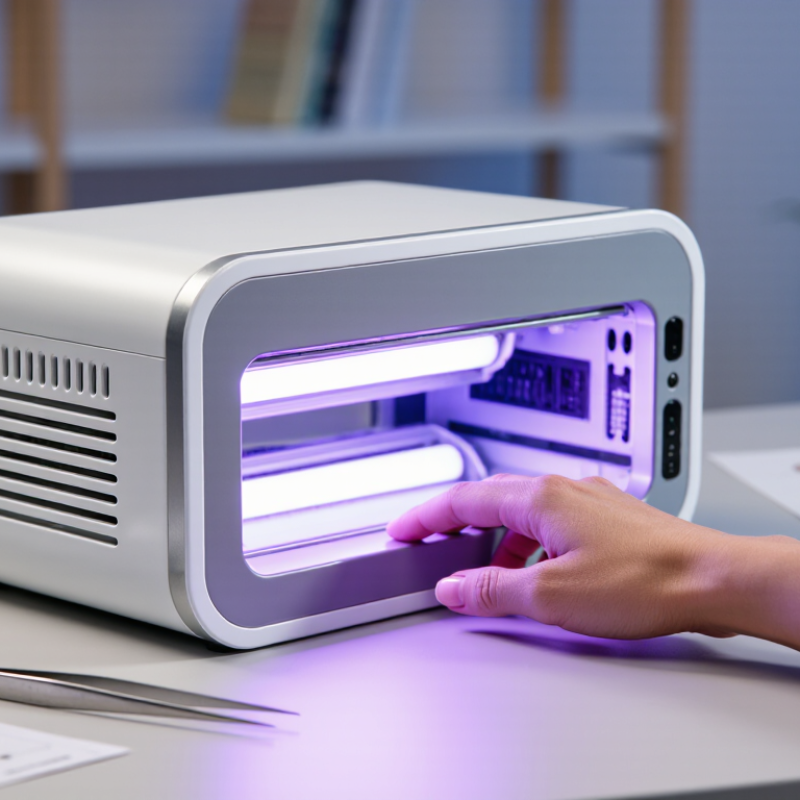
A UV drying lamp should fit your hand comfortably, not just look compact on a shelf. Check the opening width, interior height, and whether your thumb can sit flat beneath the bulbs. A removable base helps with toes and cleaning. Ease matters. If the hand shifts during curing, some nails may sit farther from the light and cure unevenly. Follow the polish maker’s curing instructions; lamp output and product requirements can differ.
Safety deserves equal attention. A 2023 Nature Communications laboratory study found DNA damage in cultured cells exposed to UV nail dryers, including after a 20-minute session. This was not a study of human skin cancer risk, so it cannot predict an individual user’s risk. Still, choose a lamp with a timer and use the shortest instructed curing time. The American Academy of Dermatology recommends applying broad-spectrum SPF 30 or higher to the hands before UV nail-lamp use.
Tips: Compare the lamp’s internal dimensions with your own hand. Check that controls are easy to reach and the timer is clear. Keep the lamp stable on a level surface. A motion sensor is convenient, but it does not replace careful timing. Small details count. A short cord or awkward opening can make regular use frustrating.
Choosing a Lamp That Fits Your Budget and Maintenance Needs
A low purchase price can be misleading if replacement parts are hard to find or expensive. Compare the full cost: the lamp, any replaceable light sources, and likely upkeep. LED-style lamps often need less frequent light-source replacement, but check the maker’s stated lifespan and warranty rather than relying on a sales estimate. Keep a little room in your budget for a timer or power-cord replacement. Small costs add up.
Check which products the lamp is designed to cure. Different gel formulas may require specific light wavelengths and curing times, so follow the product instructions instead of assuming every lamp will work. A lamp with clear timer settings and a removable base can make cleaning simpler. Look for smooth surfaces that can be wiped without trapping dust around seams. Check replacement-part availability before buying. It’s an easy detail to miss.
Maintenance should fit your routine. Wipe the lamp after use with a suitable cleaner, and keep its vents clear if the design has them. Avoid harsh solvents unless the instructions allow them; they may damage plastic. If a lamp’s output seems inconsistent, inspect it and consult its manual rather than guessing at longer curing times. I would not choose the cheapest option automatically. Still, paying extra for features you will never use is not much of a bargain.